Every October, waiting rooms fill with a familiar question: “Is there someone else who might understand what I’m going through?” Mental Health Awareness Month 2026 puts that question front and centre for practitioners right across Australia.
This article looks at why patients are searching for alternative practitioners, how referring clinicians can support that search, and what it means for your visibility as a provider this month and beyond.
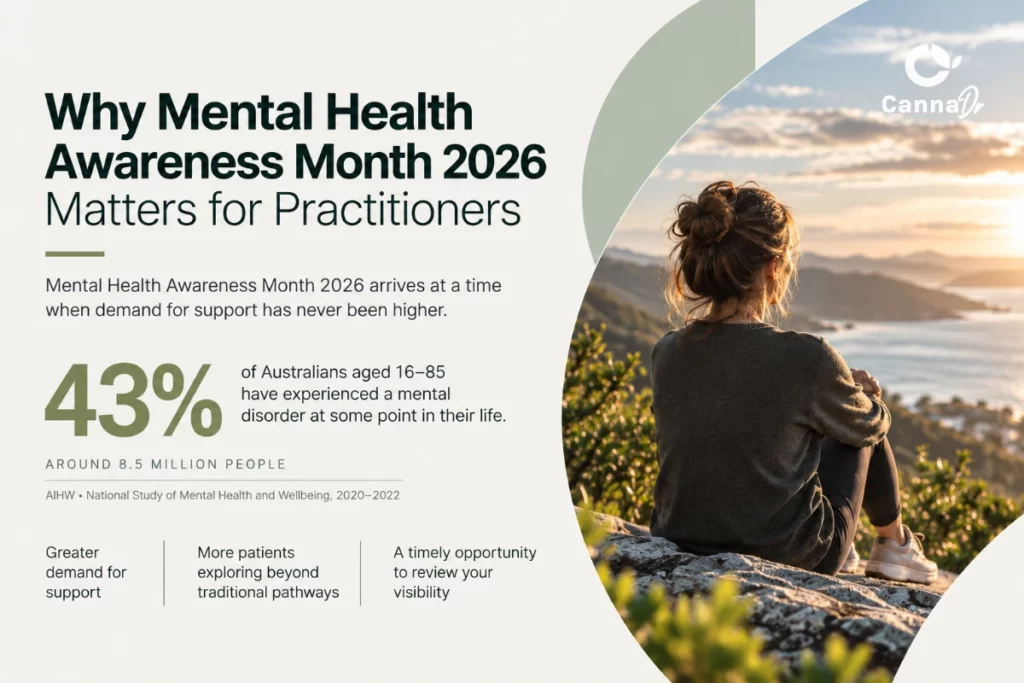
Mental Health Awareness Month 2026 arrives at a time when demand for support has never been higher. According to the Australian Institute of Health and Welfare (AIHW), an estimated 43% of Australians aged 16–85, around 8.5 million people, have experienced a mental disorder at some point in their life, based on the 2020–2022 National Study of Mental Health and Wellbeing.
That’s a significant slice of the population, and many of them are actively looking beyond the traditional GP referral pathway. For practitioners, this month is a timely reminder to review how easily patients can actually find you.
Organisations such as SA Health run dedicated campaigns each year to encourage open conversations about mental wellbeing. Practitioners can align their own outreach with these broader community efforts.
Patients increasingly want more than a single pathway to support. They’re asking about complementary mental health care alongside conventional options, not necessarily instead of them.
Common reasons patients explore alternative mental health support include:
Holistic mental health providers, from mindfulness-based therapists to naturopaths, are increasingly part of everyday conversations about wellbeing, not a niche interest.
Bringing up alternative therapy doesn’t need to feel awkward. Framing it as part of a broader support network tends to land well with patients.
A few practical approaches:
This kind of dialogue builds trust and positions you as a connector, not just a single point of contact.
Patient searches for alternative mental health support span a wide range of disciplines. Understanding this variety helps practitioners refer with more confidence.
Patients often don’t know these categories exist until someone mentions them. A short explanation from a trusted practitioner can open up options they hadn’t considered.
Integrative care coordination doesn’t happen by accident. It’s built through practitioners actively maintaining awareness of who else is operating in their area and what they offer.
Consider these steps for Mental Health Awareness Month 2026:
A well-maintained referral network benefits everyone: patients get more relevant options, and practitioners build a two-way flow of introductions.
Patients researching alternative mental health support usually start online. If your practice isn’t easy to find, that search often ends with a competitor rather than with you.
This is where platforms like CannaDr fit into the picture. CannaDr connects patients with authorised prescribers and alternative healthcare practitioners across Australia, letting people compare specialisations, appointment types, and consultation details in one place.
For practitioners, being listed means:
Increased visibility during Mental Health Awareness Month 2026 can translate into steadier patient connections well beyond October.
Marking Mental Health Awareness Month 2026 doesn’t require a large campaign. Small, consistent actions tend to have the most lasting impact.
Ideas worth considering:
These small steps keep your practice visible and relevant throughout a month when patients are actively searching.
Mental Health Awareness Month 2026 is a reminder that patients want choice, clarity, and an easy way to find the right support. Alternative practitioners for mental health are no longer a fringe interest; they’re part of how many Australians think about their wellbeing.
Practitioners who make themselves easy to find, and who build genuine referral networks, are well placed to support patients through this month and beyond. Platforms like CannaDr simply make that connection easier to build.
If you’re looking to strengthen your visibility this Mental Health Awareness Month, it may be worth reviewing how patients currently find their way to your practice, and whether a directory listing could help close that gap.